
Lawrence County Parole Versus Probation
Parole is a conditional release from a Tennessee prison sentence before the sentence expires. The Tennessee Board of Parole decides whether an eligible state prisoner receives parole, while the Tennessee Department of Correction, or TDOC, supervises the person in the community. Probation begins with a court order. A judge may impose it instead of confinement, after split confinement, or as another part of the sentence. Lawrence County criminal court records therefore matter for probation, while Board and TDOC records matter for parole.
Both statuses can mean the person is outside prison. Neither means the sentence or supervision has ended. In TDOC Felony Offender Information Lookup, called FOIL, a parole or probation status normally reflects active community supervision. An inactive status is the stronger sign that active TDOC custody and supervision have ended, but the detail still needs context. A county misdemeanor, bond release, or case that never enters TDOC may not appear in FOIL at all.
| Point | Parole | Probation |
|---|---|---|
| How it begins | Board grants conditional release from a state sentence | Sentencing court enters a probation order |
| Decision authority | Tennessee Board of Parole | Court of record |
| Field supervision | TDOC Community Supervision | TDOC Community Supervision for covered cases |
| Violation route | Board warrant, revocation, or reinstatement process | Court violation and revocation process |
| Release meaning | Outside prison, still serving the sentence | In the community under a court sentence |
Verify Lawrence County Release Supervision
A reliable check starts with identity, not a name alone. FOIL allows a name search with race and an alias option, or a search by TDOC or State ID. Match date of birth and public identifiers before reading status. The local court portal can then show whether the Lawrence County case includes probation, a violation, revocation, judgment, or later order. These records should agree on the person even when they describe different legal events.
- Open the official TDOC FOIL overview, then search by name, TDOC ID, or State ID.
- Match the result with identifiers. Read status, location, sentence, release information, and parole-hearing status without treating any one field as the whole record.
- For probation tied to a Lawrence County case, use the official Lawrence County court guide, then search the criminal docket by case number or name and inspect the actual orders.
- Use the field office only after identifying the person and status. Ask for appropriate public verification or reporting guidance, not confidential supervision details.
- If the precise parole decision matters, request the final order from the Board. A schedule or nonbinding recommendation is not the decision.
The broader Lawrence County release path is available on the released inmates search page. It begins with Booking when the last custodian was the county jail, since FOIL does not cover every local release.
Lawrence County District 51 Office
Lawrence County has a local TDOC Community Supervision office. District 51 serves Giles, Lawrence, and Wayne counties from Lawrenceburg. This is the operating contact after FOIL identifies the correct person and active status. It is not a substitute for the sentencing court, Board order, or release record, but it prevents a routine Lawrence County supervision question from being sent first to Nashville.
TDOC Community Supervision, District 51
1004 Buffalo Road
Lawrenceburg, TN 38464
Phone: 931-766-1420
Fax: 931-766-1446
The TDOC field-office directory is the source for this Lawrenceburg entry. The captured directory view shows where to expand District 51 and confirm the local listing.
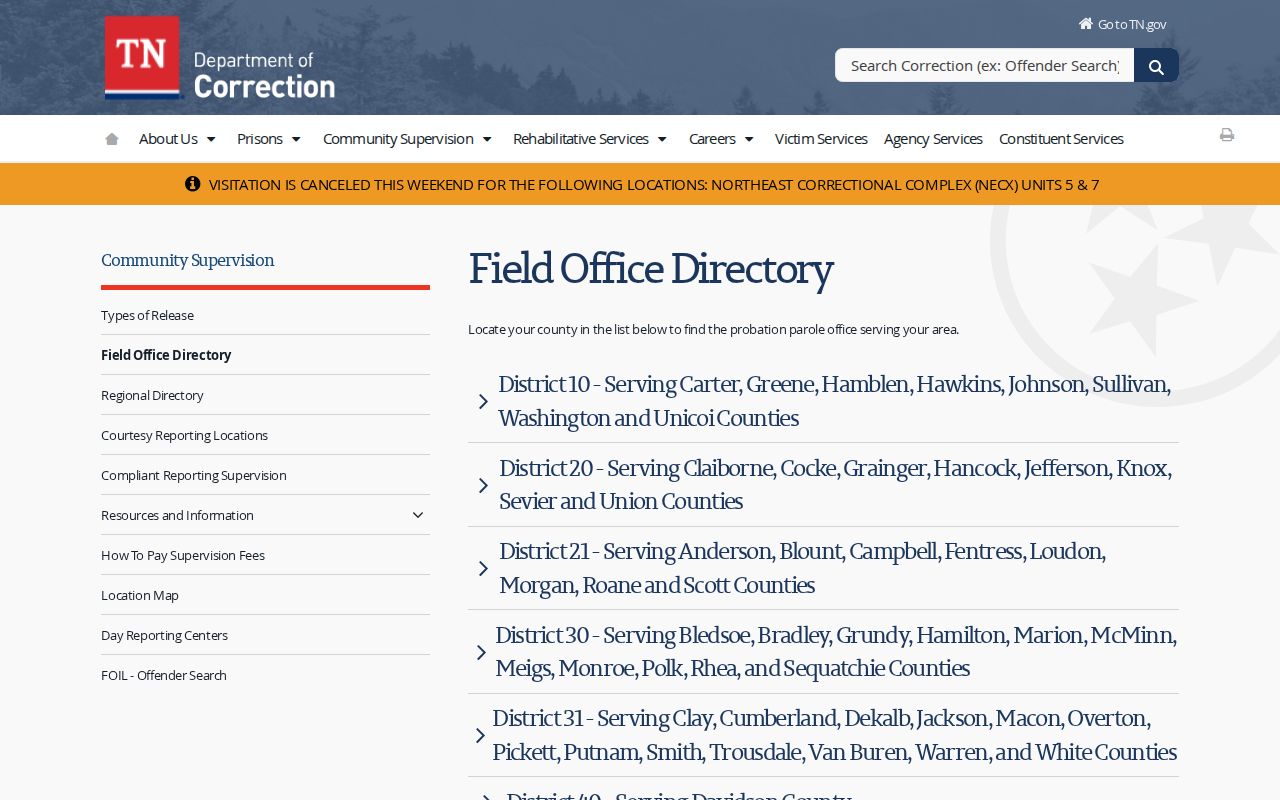
Use the office after the FOIL match so staff receive the correct TDOC identity and a focused request. Office staff determine what supervision facts may be released.
Note: A field-office call can clarify routing, but it does not turn private case-management details into public Lawrence County supervision records.
Lawrence County Supervision Terms
Several labels are easy to blur. Their meanings affect which agency holds the responsive Lawrence County record and whether the person has merely left confinement or completed the full legal obligation.
- Parole
- Conditional community release from a state prison sentence before expiration, subject to Board terms.
- Probation
- A court-ordered community sentence, sometimes imposed after a period of confinement.
- Discharge
- The formal end of custody or supervision reflected in the responsible agency's record.
- Absconder
- An agency-determined supervision status tied to alleged failure to report or comply, not a label inferred from a failed web search.
- Revocation
- A legal action that can end community placement and return a person to custody, subject to the governing process.
Mandatory reentry supervision is another Tennessee category. Under TCA §40-35-506, qualifying felony offenses committed on or after the statute's stated date can result in community supervision during the final year or for a year after sentence expiration under its terms. It should not be relabeled as an ordinary discretionary parole grant.
Lawrence County Parole Hearing Records
The Tennessee Board of Parole schedule covers eligible TDOC prisoners in state prisons and county jails. The Board says schedules update weekly on Monday, or Tuesday after a Monday holiday. Last-minute changes remain possible. A locally confined state felony offender may appear on a county-jail hearing schedule, but that fact does not mean the person has been released from Lawrence County Detention Center.
The process has distinct stages: eligibility → scheduled hearing → recommendation and Board vote → final order → approved release plan and TDOC processing → actual release. A hearing officer's recommendation is nonbinding. Board members may adopt, change, or reject it. Some matters need different vote totals, and rescission can undo a grant before release. The individual final order controls the outcome.
The Board began virtual public access for select county-jail parole hearings, but the registration form is an attendance route, not a release alert. No public statewide person-by-person decisions database was found. FOIL may display hearing status, while the Board public-records process is the documented route to request a final decision or order by offender name and TDOC number.
Board records and TDOC records also serve different purposes. A final Board order establishes the parole outcome. TDOC's release authorization documents the later correctional release process, and FOIL supplies public status and sentence information. When only the hearing schedule is available, call the Parole Hearings Division at 615-741-1150 or request the schedule through BD.HearingSchedules@tn.gov. Do not convert schedule access into an outcome claim.
A Lawrence County hearing may concern a state-sentenced person held locally. In that setting, the local jail is the physical custodian while TDOC and the Board maintain the felony sentence and parole process. Check both systems. If the person vanishes from local jail information after the hearing, ask whether TDOC received the person. Transfer into a state institution is continued confinement, not community release.
Note: Eligibility, a hearing, a favorable vote, and physical release are four separate Lawrence County parole facts and must be reported separately.
Lawrence County Violations and Warrants
No official Lawrence County-specific public absconder list was located. Do not infer absconder status because an address is stale, a person misses a private contact, or a search returns no record. The responsible agency must make that status determination. FOIL, the District 51 office, the court docket, or the issuing agency can establish what public warrant or violation information exists.
Parole and probation violations follow different authorities. A parole warrant, final revocation, reinstatement, or rescission belongs to Board procedures. A probation violation returns to the court that imposed probation. A final parole revocation may revoke or reinstate supervision, so even the word “revocation hearing” does not reveal the result. Search the order, not merely the event label.
Conditions vary by order and should not be guessed. At a high level, supervision can require reporting and compliance with the written terms. TDOC states that a probationer released after split confinement must report within 48 hours. A person released on parole also needs an approved release plan. Failure to distinguish an alleged breach from an adjudicated violation risks misstating both custody and status.
VINELink can provide a future custody or status alert for a participating source, but it is not a public Lawrence County absconder directory. Likewise, the TBI Sex Offender Registry answers only the legal registration question for people subject to that law. A registry address or status does not establish parole, probation, the date of release, or the end of supervision. Keep each system within its stated scope.
Ending Lawrence County Release Supervision
Supervision ends through an official discharge, sentence expiration, court action, or another authorized outcome reflected by the agency with jurisdiction. A person may leave prison, start parole, complete parole, and later become inactive in FOIL. Those are separate dates. For probation, the sentencing court's orders and TDOC status can document active supervision and its end. Ask for a discharge or sentence-completion record when the exact endpoint matters.
A release from incarceration should not be called discharge from the sentence. Likewise, the absence of a current jail record does not prove either parole or probation. If the Lawrence County Detention Center was the last known custodian, call Booking and ask whether the person was released to the community or transferred. If TDOC was responsible, use FOIL and, when needed, request the actual release authorization or discharge record from TDOC Records Management.
Under the Tennessee Public Records Act, request an existing record with enough detail to locate it. The Board asks for the offender name and TDOC number when available. A written request may require proof of Tennessee citizenship, may involve lawful fees, and may produce redactions. If an office denies a field, ask it to identify the legal basis. Do not ask the office to create a new supervision summary when a final order, release authorization, or discharge record already answers the question.