
Lawrence County Projected Versus Actual
Tennessee's operative state-sentence term is Release Eligibility Date, or RED. It is the first date on which a person may be considered for release under the sentence and offense rules that apply. RED is not a promise, scheduled pickup time, or completed release. A parole decision, approved paperwork, and the physical departure are also different events.
A pretrial Lawrence County detainee generally has no computed prison release date. Bond, dismissal, plea, sentencing, and court orders can change custody. A person serving a county misdemeanor sentence needs the local judgment, jail credit, and sheriff's calculation. A person serving a TDOC felony sentence follows the state eligibility and sentence-credit framework. Applying one system's date rules to another creates a false answer.
The official TDOC Types of Release explanation provides the state framework and shows why release-plan approval matters.
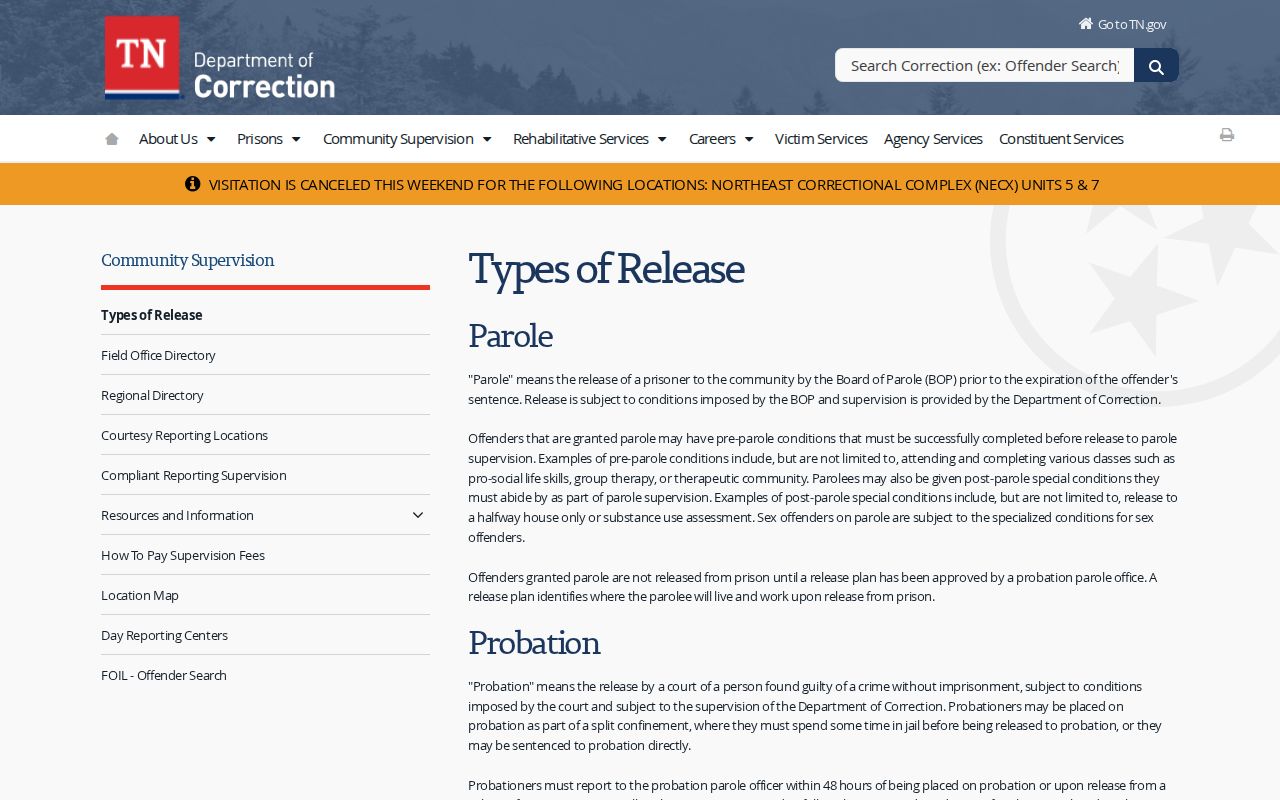
The captured state page supports the distinction between eligibility and completed release. It does not supply an individual Lawrence County exit date.
Find a Lawrence County Release Date
Begin with the last known custodian. A charge filed in Lawrence County does not prove that the person remains in the county jail. A sentenced felony offender may be in TDOC, locally confined for TDOC, or transferred. A federal or immigration hold points to another system. Confirm identity and custody before interpreting a date.
- For the Lawrence County Detention Center, call Booking at 931-766-4177. Ask whether the person remains there and whether an existing record shows the calculated date, actual release, or transfer destination.
- Use the official county court guide, then search the Lawrence County criminal docket for bond, judgment, sentence length, jail credit, revocation, or later orders. Do not infer an exact exit time from the court event.
- If TDOC involvement is plausible, open FOIL. Search by name, TDOC ID, or State ID and match the record with identifiers.
- Read sentence and release information, status, and parole-hearing information. Use the exact current labels shown rather than inventing a “projected release date” field.
- For a precise state release fact, request the release authorization or discharge record from TDOC Records Management.
FOIL covers felony offenders currently or formerly in TDOC custody or supervision. Incarcerated reflects confinement in the TDOC-reported system. Probation and parole usually indicate community supervision after release from prison. Inactive generally means no active TDOC custody or supervision, but the underlying detail still controls. FOIL is not a same-day county jail release list.
The full county verification route, including transfers and other custody types, appears on the Lawrence County released inmates page.
Lawrence County RED Is Eligibility
A Tennessee RED starts with the judgment and the law governing the offense date. The calculation can depend on the offense, sentence length, sentencing range or classification, and whether multiple sentences run at the same time or one after another. Lawful pretrial or jail credit is then applied. Only credits permitted for that sentence may affect eligibility.
The release path continues after the calculation. Parole is discretionary where available. A Board grant still does not prove physical release because a release plan must be approved and TDOC must complete release processing. A detainer, rescission, record correction, or another hold can keep the person in custody after the eligibility date. That is why a projected Lawrence County release date must always be labeled by type.
- Read the judgment, offense date, sentence, classification, and consecutive or concurrent structure.
- Apply the version of TCA §40-35-501 that governs that offense and date.
- Apply lawful pretrial and jail credit.
- Apply only credits available under TCA §41-21-236 and TDOC policy.
- Account for disciplinary losses and corrections to the sentence record.
- After RED, check Board action, plan approval, detainers, rescission, and actual release authorization.
Note: Booking date, sentence date, RED, hearing date, Board decision, actual release, supervision start, and discharge are not interchangeable dates.
Lawrence County Truth-in-Sentencing Rules
Tennessee has no universal rule that every sentenced person serves 85 percent. TCA §40-35-501 contains offense-specific release eligibility rules. Public Chapter 988 created truth-in-sentencing categories for specified offenses committed on or after its effective date. One enumerated category is served at 100 percent without release eligibility, with credits unable to reduce the sentence for release.
Another enumerated category also begins at 100 percent, but satisfactory program credits may advance release eligibility by no more than 15 percent. That limited category produces the phrase “no earlier than 85 percent.” Other sentences follow different eligibility percentages and rules. Offense lists and amendments are detailed, so the current governing statute and judgment must be used instead of assigning the 85 percent phrase to every Lawrence County sentence.
The official legislative history for Public Chapter 988 documents the enacted truth-in-sentencing change.
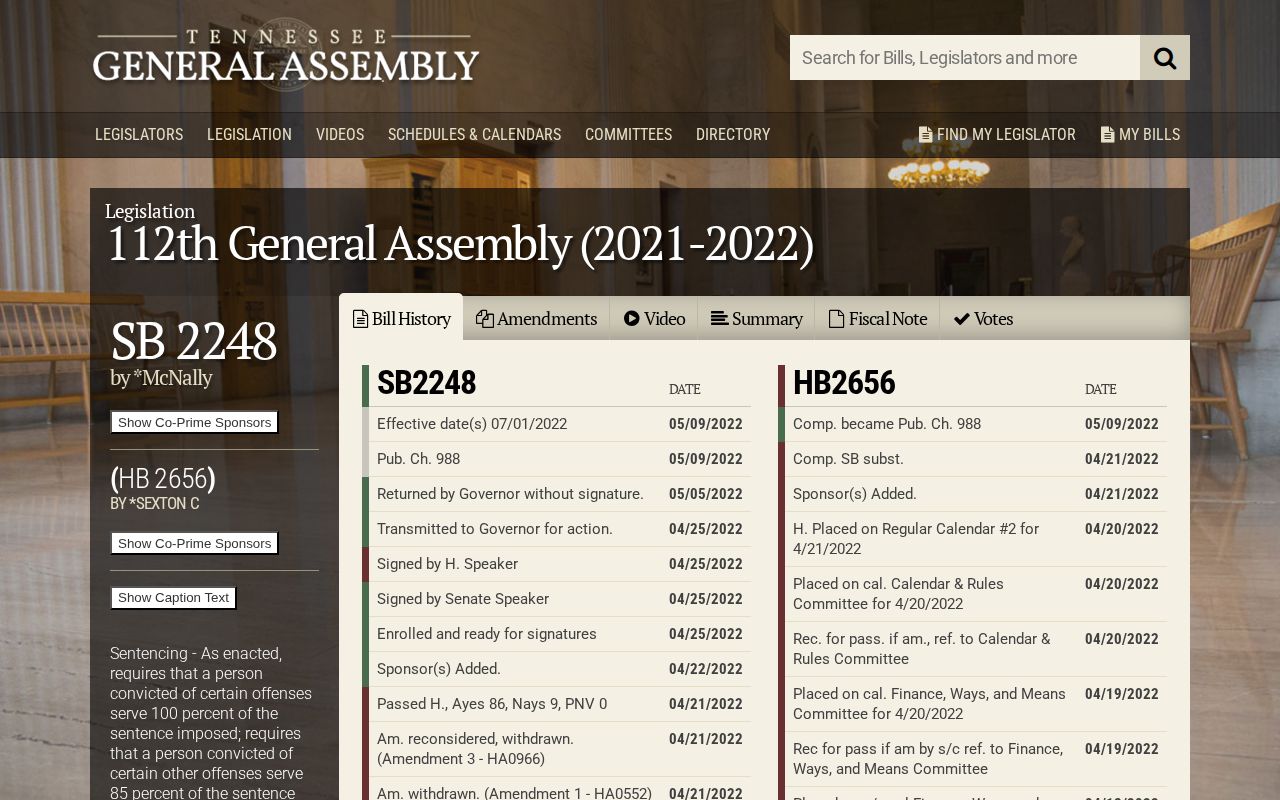
The history helps identify the change in law. The individual offense date, judgment, and current statute still decide which release eligibility rule applies.
Note: The 85 percent shorthand applies only to a defined Tennessee category and cannot be assigned to every Lawrence County sentence.
Lawrence County Sentence Credit Limits
TCA §41-21-236 and TDOC policy govern state sentence credits. The TDOC offender handbook calls credits a privilege, not a right. Its potential prison sentence reduction schedule describes behavior credits, program credits for qualifying full-time activity, possible minimum-custody bonuses, and certain one-time education or therapeutic-program credits. Eligibility and actual awards are conditional.
The published schedule includes four behavior-credit days per month during the first calendar year and six after that. It also describes up to six program-credit days per month for qualifying full-time programming, possible minimum-custody bonus credits, and certain one-time 60-day credits. These are potential state-prison credits. They are not a promise that a particular person will receive the maximum.
Disciplinary or classification events can withhold or remove credit and extend RED. Sentence data can also be corrected. For that reason, a private arithmetic estimate should never replace the active TDOC calculation. Search the official record and ask TDOC for the computation record when a material discrepancy remains.
- RED
- The date on which release consideration may first begin under the governing rules.
- Jail credit
- Lawful credit for qualifying time already held before or during the sentence.
- Sentence credit
- A conditional credit authorized by statute and correctional policy.
- Detainer
- A request or legal hold from another authority that may prevent community release.
- Discharge
- The formal end of custody or supervision, distinct from eligibility.
Lawrence County Jail Date Calculations
No Lawrence County good-time policy or weekend-release rule was found in the official online sources. Do not import TDOC's prison credit schedule into a county misdemeanor sentence. The sheriff and court apply the local judgment, lawful jail credit, and governing rules to the county record. The existing jail calculation or release record is the target, not a formula built from state-prison maximums.
For a county-sentenced person, request the record that shows the calculation. Ask the clerk for the judgment and any order affecting credit. Ask Booking whether another case, hold, transfer, or revised calculation is recorded if the expected date passes but custody continues. Staff may direct a formal request to the sheriff's records contact.
A pretrial detainee requires different questions. Ask whether bond is set, whether another hold exists, and whether the person remains physically present. The General Sessions court can review bonds and handles misdemeanors and preliminary felony matters. Circuit Court handles felonies. A docket entry can explain the legal event, but it does not replace the sheriff's actual release timestamp.
Note: No official online Lawrence County good-time or weekend-release rule was found, so request the existing local calculation record.
Changes to Lawrence County Release Dates
Projected dates move for reasons that arise from the sentence, correctional record, another agency, or the parole process. Identify the documented cause rather than guessing from a changed web value.
| Factor | Possible effect | Best record |
|---|---|---|
| Earned credits | May advance eligibility where legally allowed | TDOC computation record |
| Credit loss | May extend RED after disciplinary action | TDOC sentence and disciplinary records |
| Judgment correction | Can change sentence length or credit | Court order and corrected calculation |
| Detainer or hold | Can prevent community release or cause transfer | Custodian and receiving-agency record |
| Parole decision | Grant, denial, revocation, or rescission changes the path | Final Board order |
| Release plan | Unapproved plan can delay parole release | TDOC and Board records |
A hearing schedule does not show the final outcome. A hearing officer recommendation is not binding, and a Board grant is still earlier than the completed TDOC release authorization. If a Lawrence County person is locally confined for a state felony, disappearance from local jail information can also mean transfer to a TDOC institution rather than release to the community.
Rescission deserves special care. The Board can revisit a grant before release, and TDOC still must verify the record and authorize departure. A favorable decision date therefore cannot stand in for the actual release date. Request the final Board order when the outcome matters and the TDOC release record when the completed departure matters.
Confirm Lawrence County Actual Release
For the county jail, Booking is the direct actual-status source. Ask whether the person remains present and, if not, the recorded date, disposition, or receiving agency. For TDOC, compare FOIL status and release information with the release authorization or discharge record. TDOC Policy 511.03 treats record verification and authorization as distinct steps, which is stronger evidence than eligibility alone.
A future alert can help track a state or participating local custody change. The Lawrence County VINELink check explains how to match one person and enroll through Get Notified. An alert is still a prompt to verify with the named custodian, especially when release and transfer events occur close together.
For an older or disputed TDOC date, use the archived offender-record request route. Provide the offender's full name, TDOC number, date of birth when known, and a precise description of the record. Ask for the release authorization, actual release date and type, sentence expiration or discharge record, and supervision start or end as needed. TDOC may give notice of archive search charges, so do not assume or prepay a figure.
For a final parole outcome, use the Tennessee Board of Parole public-records process and include the offender name and TDOC number. No separate statewide person-by-person decisions database was found. FOIL hearing status is useful context, but it is not a substitute for the final order. The order establishes the decision, while TDOC's later authorization establishes the completed correctional release.
Preserve the source, date type, time checked, and exact public wording. If two records conflict, ask the office that created the disputed record. Report “eligible,” “scheduled,” “granted,” “released,” and “discharged” only when the evidence supports that exact stage.